Copyright © Every Day Japan
Design by Dzignine
Showing posts with label Food. Show all posts
Friday, November 30, 2012

精米機:Rice Machine

Let me introduce you to a thing that I think many native Japanese people aren't too familiar with:

精米機
( せいまいき / seimaiki )
pour the rice in here
You non-Japanese people are saying: "What's this?"
You Japanese people are saying: 「これ何!?」

Well let me enlighten you. Simply, this could be called a rice cleaning machine. If you don't know yet, rice isn't born white. After the rice grows to its maturity, the farmer takes a blade to it and decapitates it. They collect all the heads and then strips each one so that each grain comes loose. Unfortunate these grains still have their shells, and, unless you have tons of kids and tons of time, you probably wont try to deshell them by hand. This is where the machine comes into play:

Pour the (shelled) rice into the machine...and out comes beautiful, deshelled, white rice!

put the bag down here 
Unless your a big-time farmer, you probably don't grow your own rice. You buy rice in big bags like the ones shown above. 

1) Bring the bag of rice to the machine (In the country-side these machines can be found everywhere)
2) Usually these machines are coin-operated. So, pay the appropriate amount (300¥ for 30 kg)
3) Open the bag
4) Pour the rice in the hole
5) Place the empty bag under the hole where the rice comes out
6) Start the machine (or it may start by itself)
7) Wait for beautiful rice to come out!

The whole process takes around 5 to 10 minutes.

Now, I said that some Japanese may not be familiar with this. I say this because I think that this is a machine used mostly by country-side folk (like me!). I mean, I just don't expect Tokyo city-folk to use this on a daily/monthly basis (I may be wrong of course).

Well, that's it about  rice cleaning machines. If you have time watch this video below. If you don't have time, watch it anyways! (Again, the whole process is only like 5 minutes or so). And if you absolutely don't have time, watch it and fast forward through the boring parts.


Until next time, またね~
Saturday, November 24, 2012

美味しい:delicious!

Question: What do you say after eating this?

some gyoza we just made
Here's the word of the day~

美味しい
( おいしい / oishii )

You and your friends go to eat out. You order food. Wait a few minutes. Bam, the waiter comes out with your food. You pray over your meal (or you don't :P). Now comes the itadakimasu. You take a bite of your food and then...

Oishii! Oh boy. If you are even remotely interested in Japanese culture, you know that this is the word for "delicious" or "tasty"! Of course, just like in America, you can use this word even when you don't mean it.

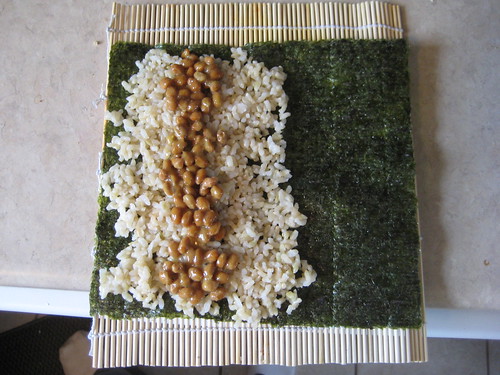
Taking a bite out of that natto-nori...."oishii"...(oh help me...)

The word is made out of two kanji characters: "Beautiful" (美) and "Taste: (味). Pretty straightforward. If something has a beautiful taste, it is delicious.

Ok, dinner is calling. Time to eat some おいしい food!
いただきます~
Monday, November 19, 2012

鶏のなんこつ唐揚げ: Soft bone chicken Karaage

I love food. I won't deny it...and neither will you! Perhaps one of the reasons why I fell in love with Japan and its culture is its delicious delicacies. Japan has sushi, tenpura, chicken katsu, tonkatsu, sashimi, ramen, and the list literally goes on and on. Moving to Japan has become heaven for my taste buds, and unfortunately my waist line as well :(

Among one of my favorite foods is (chicken) karaage:

唐揚げ
( からあげ / karaage )

Wikipedia doesn't do it enough justice with its meager 1/2 page of content, but karaage is amazing. To an American, I would simply call it Japanese fried chicken, but anyone who's eaten it knows that its more.

Even more surprising to me is the face that it had another trick up its sleeves. Thus, let me present to you:

鶏のなんこつ唐揚げ
Chicken soft bone Karaage

that's right, soft bones
You've got your normal chicken karaage exterior and a wonderfully delicious, crunchy soft bone interior. I found these little treasures while dining at Joyful today. Just one bite and my Filipino desires went crazy for more. Needless to say, I ate everything, including the plate...and the menu.

So, if you ever stop in Japan, try these little wonders. Even if you aren't a fan of soft bones, I think you'll enjoy eating a piece of karaage that lasts a few seconds longer. Another good thing is that its cheap. This dish from Joyful rings up to 299 Yen, around $3. So try it!

Eat well my fellow travelers~ またね!

Thursday, November 8, 2012

焼き鳥: Japanese Fried Chicken

Take a look at this!

おいし= delicious
Great, I've got your attention (food has always worked for me)! This, my fine friends, is a picture of 

焼き鳥
( やきとり / yakitori)

Roughly translated, comes out to baked/fried/grilled chicken. The first character is "to grill" (焼) and the other is "bird" (鳥). Pretty simple, don't you think?~

Yakitori is a must have in Japan. These are basically comparable to BBQ shish kabobs and can be found in tons and tons of restaurants (not to mention food vendors sprawled throughout towns and service areas).

Although it can be translated as "fried chicken" or even "grilled chicken", please don't expect it to look like what you'd normally see in America. In fact, most yakitori is comprised of bite-sized pieces of meat and of course served via skewer or sharp-pointy-stick.

Many times you are given the choice of having your yakitori cooked in salt (shio) or with a sauce generally made up of mirin, sake, soy sauce, and sugar.

Now, I've always known that this food was darn good, but when I took a bite out of this last bunch, I noticed a few different words on my kabob sticks. I've outlined them below:

ねぎま: Chicken with green onions
もも: Chicken thighs
レバー: Chicken livers
つくね: Minced chicken
かわ: Chicken skin

I tried all of these and found all of them to be quite delicious. So far, my favorites are もも and かわ.

Wikipedia says that there are other kinds that can be purchased, but alas, I have not been fortunate enough to eat them yet. However, when I do, I will be sure to make a follow-up post.

The main point is, if you come to Japan, please try this. You won't regret it!

Until next time, またね!