Copyright © Every Day Japan
Design by Dzignine
Showing posts with label Kanji. Show all posts
Saturday, November 24, 2012

美味しい:delicious!

Question: What do you say after eating this?

some gyoza we just made
Here's the word of the day~

美味しい
( おいしい / oishii )

You and your friends go to eat out. You order food. Wait a few minutes. Bam, the waiter comes out with your food. You pray over your meal (or you don't :P). Now comes the itadakimasu. You take a bite of your food and then...

Oishii! Oh boy. If you are even remotely interested in Japanese culture, you know that this is the word for "delicious" or "tasty"! Of course, just like in America, you can use this word even when you don't mean it.

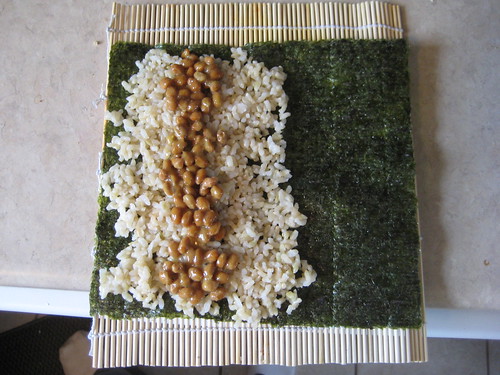
Taking a bite out of that natto-nori...."oishii"...(oh help me...)

The word is made out of two kanji characters: "Beautiful" (美) and "Taste: (味). Pretty straightforward. If something has a beautiful taste, it is delicious.

Ok, dinner is calling. Time to eat some おいしい food!
いただきます~
Wednesday, November 21, 2012

田んぼ: Rice fields

When I first visited Japan, back in the summer of 2009, I went to where everyone first thinks of visiting: Tokyo. It had always been my dream of visiting Japan, and of course I had to go to Tokyo.

I remember arriving in Narita International airport being totally dazed and confused (I had only studied Japanese for a year at that point). On top of that, I was a little sick. This was during the 2009 Swine Flu Pandemic, and I was actually pretty worried that they would throw me into quarantine and/or deport me back to Hawaii.

Miraculously, I am not stopped, I get my bags, and am ready to make my way into the gigantic metropolis of Japan, when my friend/guide tells me that we gotta ride a train to get to Tokyo. Also, it's going to be an hour or so train ride. Well, I guess I can wait an hour.

We hop on the train, travel through a bunch of tunnels, and then finally the light of day breaks through the windows. I take a peak outside, ready to see gigantic buildings, robots, Godzilla, and Ultraman, but all I see are rice fields. Well, I found out later that Narita wasn't a big city at all. It's basically just farmland and an airport. Really?! An international airport in the middle of nowhere? Whatevers~

Well, let me introduce the word of the day:

田んぼ
( たんぼ / tanbo )

If you come to Japan, be prepared to see the rice fields (tanbo) everywhere! Like I mentioned earlier, even if you do just decide to spend all your time in Tokyo, you will still see rice fields on the way there.

tanbo right next to our house
Of course if you get away from the city, you'll see this more and more. As you probably are well aware, rice is a staple in Japan. You either eat rice or noodles with every meal, and sometimes the noodles are even made out of rice! You even have some dishes that are over 90% rice: sushi, onigiri, etc.

I've been living in Japan for a few months now and I am still in awe of these rice fields. To me, they are beautiful and add such a wonderful color to the land. My meager cell phone camera don't do these fields justice; they should be at least 3 times brighter and greener!

Well, just for your viewing pleasure, I've inserted pictures of some very special rice fields in Japan. If you know where these fields can be found, let me know, and I'll add another post about it later. Until then, enjoy!
またね~


Tuesday, November 13, 2012

垂れ目:Droopy Eyes

Now, I'll be one of the first to admit that I don't have a splendid eye for fashion or an inkling on how to become more beautiful or gorgeous (my only advise is to exercise/workout -_-), but I thought I knew what a droopy eye was before I came to Japan.

Just the other day, I was told that I had:

垂れ目
( たれめ / tareme )

A quick consultation with a dictionary will tell you that this means "drooping/droopy eyes".

What?! I know I'm no Brad Pitt, but I never knew I was this:

whatcha looking at kid?!
Well, apparently I was in the wrong because it was soon explained to me that having 垂れ目 was a compliment. It meant that I had nice curves to eyes; even better, the edges of my eyes slanted downwards.

Now, I don't know if it was just the way that I slept the night before, or if I've always been blessed with droopy eyes, but either way I was shocked and happy at the same time. Happy because no one has ever complimented my eyes before (why do blue/green-eyed people get all the compliments?!), and shocked because I could never imagine people wanting droopy eyes.

In America if someone says you've got droopy eyes, you've either:

1) Have a medical condition
2) Been training for the UFC too hard
3) Been hitting the drugs too hard

And only number 2 sounds like it has any merit. 

The point is, in Japan, having droopy eyes means something totally different. Even after reading my banter, I still would recommend talking to a good ol' fashioned Japanese High School girl because she could probably explain the detail a whole lot better. But, simply look at this picture and try to understand:

look into my eyes...
Yep, droopy eyes are beautiful in Japan. That's all there is to know.

Hope you learned something! I kinda did...kinda~

おつかれさま!
Thursday, November 8, 2012

焼き鳥: Japanese Fried Chicken

Take a look at this!

おいし= delicious
Great, I've got your attention (food has always worked for me)! This, my fine friends, is a picture of 

焼き鳥
( やきとり / yakitori)

Roughly translated, comes out to baked/fried/grilled chicken. The first character is "to grill" (焼) and the other is "bird" (鳥). Pretty simple, don't you think?~

Yakitori is a must have in Japan. These are basically comparable to BBQ shish kabobs and can be found in tons and tons of restaurants (not to mention food vendors sprawled throughout towns and service areas).

Although it can be translated as "fried chicken" or even "grilled chicken", please don't expect it to look like what you'd normally see in America. In fact, most yakitori is comprised of bite-sized pieces of meat and of course served via skewer or sharp-pointy-stick.

Many times you are given the choice of having your yakitori cooked in salt (shio) or with a sauce generally made up of mirin, sake, soy sauce, and sugar.

Now, I've always known that this food was darn good, but when I took a bite out of this last bunch, I noticed a few different words on my kabob sticks. I've outlined them below:

ねぎま: Chicken with green onions
もも: Chicken thighs
レバー: Chicken livers
つくね: Minced chicken
かわ: Chicken skin

I tried all of these and found all of them to be quite delicious. So far, my favorites are もも and かわ.

Wikipedia says that there are other kinds that can be purchased, but alas, I have not been fortunate enough to eat them yet. However, when I do, I will be sure to make a follow-up post.

The main point is, if you come to Japan, please try this. You won't regret it!

Until next time, またね!
Sunday, November 4, 2012

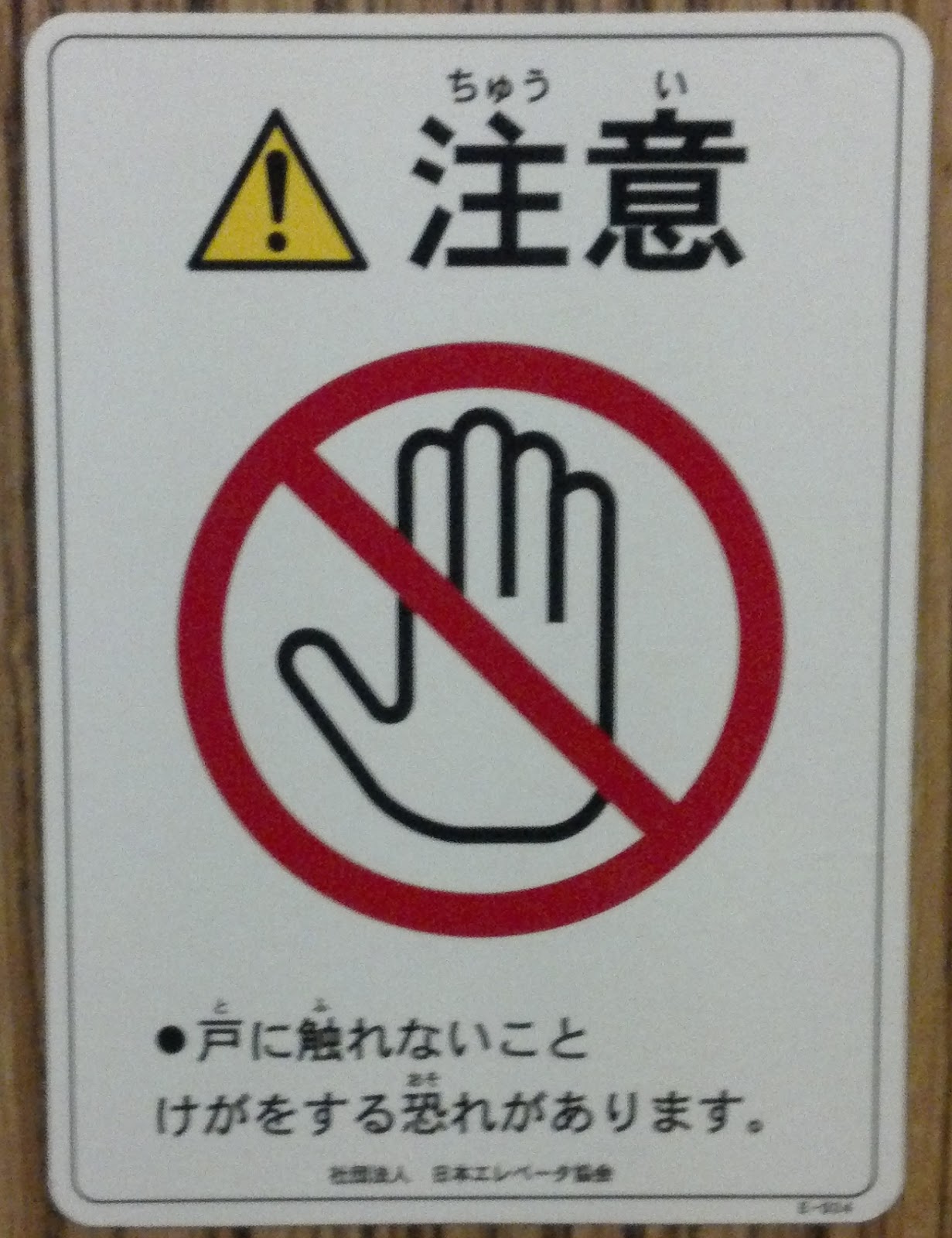
注意:Watch out!!!

If you come to Japan, you will probably see this picture (or these words) in many places that you go:

Stop, in the name of love...

I took this picture inside an elevator (エレベーター), but you can find it on tons of other signs in tons of different places. I've found this on signs telling you to pick up your dog poop or on power generators on the side of buildings. So what is this word!?

注意
( ちゅうい / chuui )

This is Japan's version of "caution", "warning", "attention", or simply, "watch out!!" This word is made up of the kanji "to pour" (注) and "opinion" or "thought" or "feeling" (意). Basically you can think of this as meaning: "Pour your thoughts into this."

When you really think about it, if you really pay attention to something, you are pouring your attention or thoughts into it. And, if you're not, you're probably not cautious enough.

Well, again if you see this sign it could mean something really important...but at the same time, it usually just means to "use your brain a little"; don't put your hand here (or you'll lose a finger), pick up your poo (or someone's gonna be mad when they step in it), and don't touch this (or you're gonna die of electrical shock).

So everyone please 注意!

みんな、がんばって!
Monday, October 29, 2012

仕事: True work involves serving others

Today's word should be memorized by anyone who wants to work in Japan. That word is:

仕事
( しごと / shigoto )

Or in other words, "work" or "employment" or "occupation" if you really want to get technical. You can use this word as a noun or you can use it as verb with the addition of "suru" (する). 

A closer look at the kanji will probably give you a closer look at Japanese society altogether. The first character means "serve" (仕) while the second basically means "business" (事). All in all, if you put these two together, your roughly get a feeling of a business based upon service.

I think the Japanese really live up to the word "shigoto" and you can see it in everything that they do. The customer is on a higher level (especially in terms of formal language) and is treated with the utmost respect. Even the lowest of workers (at least in Americans' eyes) are trained to serve the customer with outstanding dignity and respect.

Anyways, learn this word and then enjoy this picture of a gas attendant in Japan (and hopefully chuckle a little, ok?)

Japanese gas workers will do anything to serve you, even if they are really short
Anyways, keep studying and がんばって!
Tuesday, October 23, 2012

安心:Peace of Mind

Well this is an easy word that is used a lot:

安心
( あんしん / anshin )

The word means to have "relief" or "peace of mind". If some one is worried about something or stressed out, you can say to them, "anshinshite kudasai". To roughly translate, this would be, "please have peace of mind", or easier, "calm down please" (I like this one better).

This word is made out of the characters for "peace/peaceful" (安) and "heart" (心). Put it together and you have a "peaceful heart", or in other words, "peace of mind". Makes tons of sense right?

Love and Peace!
Well, when you're studying, don't get too excited! Anshinshite kudasai!
相変わらず、がんばって!
Sunday, October 21, 2012

教会: Church

This is the perfect word to memorize for Sunday:

教会
( きょうかい / kyoukai )

This is the word for Church. I've known it for a while, but it was only within the last couple months that I learned the kanji for it, so I thought I'd share it today.

The characters that make up this word are "to teach" (教) and "to meet" (会). For me the meaning could be seen as the "place where people meet/gather to teach each other". Of course it could also be seen as the "place where people meet to be taught", but I like my first one better.

Anyways, it's been a long day of Church, so...good night!

LDS Temple in Tokyo
Always keep studying~ がんばって!
Saturday, October 20, 2012

教室: Classroom

If you're going to teach in Japan, this is probably going to be a very important word to remember:

教室
( きょうしつ / kyoushitsu )

Every teacher needs to know the word for "Classroom". 

The characters that make up this word are "to teach" (教) and "room" (室), and with many other Japanese words, makes total sense. The "room that you teach in" is indeed your classroom.

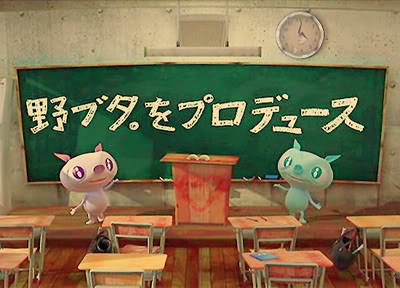
if you wanna watch a good school j-drama watch Nobuta wo Produce

Well, study your Japanese everyday, and I'll see you next time~ がんばって!
Friday, October 19, 2012

気持: Feeling/Mood

This is a word that probably all learners of Japanese are familiar with:

気持ち
( きもち / kimochi )

This word means "feeling" or "mood" and can be used the same way you use it in English. You can have an uneasy feeling, a bad feeling, a good feeling, etc. 

The individual characters here are "spirit/energy" (気) and "to have/to hold" (持). So, what kind of spirit/energy do you have at the moment? That is your mood...isn't it?

i love Calvin and Hobbes

Everyone, good luck! みんな、がんばって!
Wednesday, October 17, 2012

新着: New Arrivals

Well, I just saw this word on TV and wanted to add it to my vocabulary (and yours too if you want). The word is:

新着
(しんちゃく / shinchaku)

This word means "new arrivals", and is used when a store gets a new product or item in their line-up.
The individual characters are "new" (新) and "arrive" (着); very, very logical, don't you think?

Anyways, that's it!


Cheers! 日本語がんばって!

PS. When I first started learning Japanese, I used to hate Kanji! It was so extremely hard and I thought that the lines and strokes had no rhyme, reason, or logic behind them...but after studying Kanji more diligently I have found that it is one of the funnest parts about the Japanese language. So if you're studying Kanji at the moment, don't fret! Just keep studying and it will all come together soon!
Tuesday, October 16, 2012

勉強:To study

Well, since you're here you might as well learn some Japanese. So, if I learn something interesting in the Japanese language, I'll share it with you. Maybe this is more for me...but hey, maybe you'll get something out of it!

And the word of the day is:

勉強
( べんきょう / benkyou )

Individually, these characters mean "try hard" (勉) and "strong" (強).
So, if you think about it, if you try really, really hard to do something, it is in effect studying.

That's it! Super simple huh? Well hopefully since I blogged about it I can remember the darn characters...

study hard everyone!
Until next time, がんばって!