Copyright © Every Day Japan
Design by Dzignine
Friday, November 9, 2012

My suggestion for Katakana カタカナ

Katakana is one of the three written languages used in Japanese. I like to describe it like this:

Kanji- Chinese characters that will give you a headache. Used for Japanese words.
Hiragana: Japanese characters that are wavy and beautiful. Used for Japanese words.
Katakana: Japanese characters that are very rigid and straight. Used for foreign/loan words.

So, what's my beef with Katakana? Well, personally, I hate it! I'm terrible at reading and writing it (even after studying  Japanese for 4+ years). AND there are many Japanese natives who confess that they have trouble with it!

One reason that katakana is so hard for Japanese learners is (and this is just my opinion) that it doesn't have enough characters to compensate for all of the phonemes found in other languages.

Here's an example:

Yummy oil!
If you look at the big, blue letters you'll read:

ヘルシー
ライト

In other words, "healthy" and "Lite/Light" (oil with low cholesterol ).

What's wrong you say? Well, the word ライト can also refer to the word "right" or "rite". In fact, when I first read this word (on this bottle of oil) I let slip the "right" before correcting it to "lite". This is just one out of possibly hundreds of examples, but the bottom line is, the current system of Katakana is not sufficient for all words that could possibly be borrowed from around the world.

Well, I want to offer a suggestion (instead of just ragging on Japanese). Perhaps, the government should think about adding more characters or symbols (in addition to ゛ and ゜) to this written language. For example an additional symbol to this ラ could help us know if this should be an /l/ or /ɹ/.

I think Kanji and Hiragana are fine the way they are, but Katakana I believe will continue to be used more and more as Japan is influenced more and more by foreign entities.

Have you had any difficulties reading, writing, or remembering Katakana? What do you think? Please leave your comments below.


Thursday, November 8, 2012

焼き鳥: Japanese Fried Chicken

Take a look at this!

おいし= delicious
Great, I've got your attention (food has always worked for me)! This, my fine friends, is a picture of 

焼き鳥
( やきとり / yakitori)

Roughly translated, comes out to baked/fried/grilled chicken. The first character is "to grill" (焼) and the other is "bird" (鳥). Pretty simple, don't you think?~

Yakitori is a must have in Japan. These are basically comparable to BBQ shish kabobs and can be found in tons and tons of restaurants (not to mention food vendors sprawled throughout towns and service areas).

Although it can be translated as "fried chicken" or even "grilled chicken", please don't expect it to look like what you'd normally see in America. In fact, most yakitori is comprised of bite-sized pieces of meat and of course served via skewer or sharp-pointy-stick.

Many times you are given the choice of having your yakitori cooked in salt (shio) or with a sauce generally made up of mirin, sake, soy sauce, and sugar.

Now, I've always known that this food was darn good, but when I took a bite out of this last bunch, I noticed a few different words on my kabob sticks. I've outlined them below:

ねぎま: Chicken with green onions
もも: Chicken thighs
レバー: Chicken livers
つくね: Minced chicken
かわ: Chicken skin

I tried all of these and found all of them to be quite delicious. So far, my favorites are もも and かわ.

Wikipedia says that there are other kinds that can be purchased, but alas, I have not been fortunate enough to eat them yet. However, when I do, I will be sure to make a follow-up post.

The main point is, if you come to Japan, please try this. You won't regret it!

Until next time, またね!
Tuesday, November 6, 2012

声が低い:A low-deep voice

This is an example of a difference in word choice. In America, when we listen to someone talk with a good bass-like voice, we say that he/has a "deep voice". 

However, Japan is different. In order to say that someone has a deep, rumbling, booming voice you have to say something like, "彼の声が低い” (kare no koe ga hikui).

Directly translated comes out to "his voice is low". 

In English, if someone's voice is low, it means that the volume of his voice is low (or soft). Then you reply, "speak up! I can't hear ya!"


Well, this isn't Japanese at all, but I thought it was someone related because a Japanese person would probably say that he has a low voice.

Hope you learned something! Now use it!

日本語がんばって~
Sunday, November 4, 2012

寝てください: Please sleep soundly

Imagine this: You are a 10 year-old kid in America. You've been working hard on your homework all day, and finally, finally, finally you're able to complete it right before dinner. 

You eat dinner like a zombie, lethargically spooning heaps and heaps of food into your mouth. Right as you finish, your mom tells you to brush your teeth and then ________ (?)

Choices:
a) quickly go to bed
b) take your time and fall asleep
c) take sleeping pills
d) watch the news in order to fall asleep quicker

If you answered (a) you're correct!!!

Japanese sleeping pillow

Incidentally, in Japan, your Japanese mother (okaasan) would tell you differently.

In this situation a Japanese person would tell you "ゆっくり寝てください” (yukkuri netekudasai), or roughly translated, "please sleep slowly".

Of course it doesn't mean that you should take 3 hours to fall asleep, nor does it mean you should take your time to prepare for bed, but I think it falls more upon the lines of sleep soundly.

So, if a Japanese person says this to you, don't look at them like they said something outrageously idiotic (like I did :P), simply nod your head, quickly go to sleep, and then take your time in the land of dreams.

Well, it's almost time to sleep, so everyone: ゆっくり寝てください and またね!

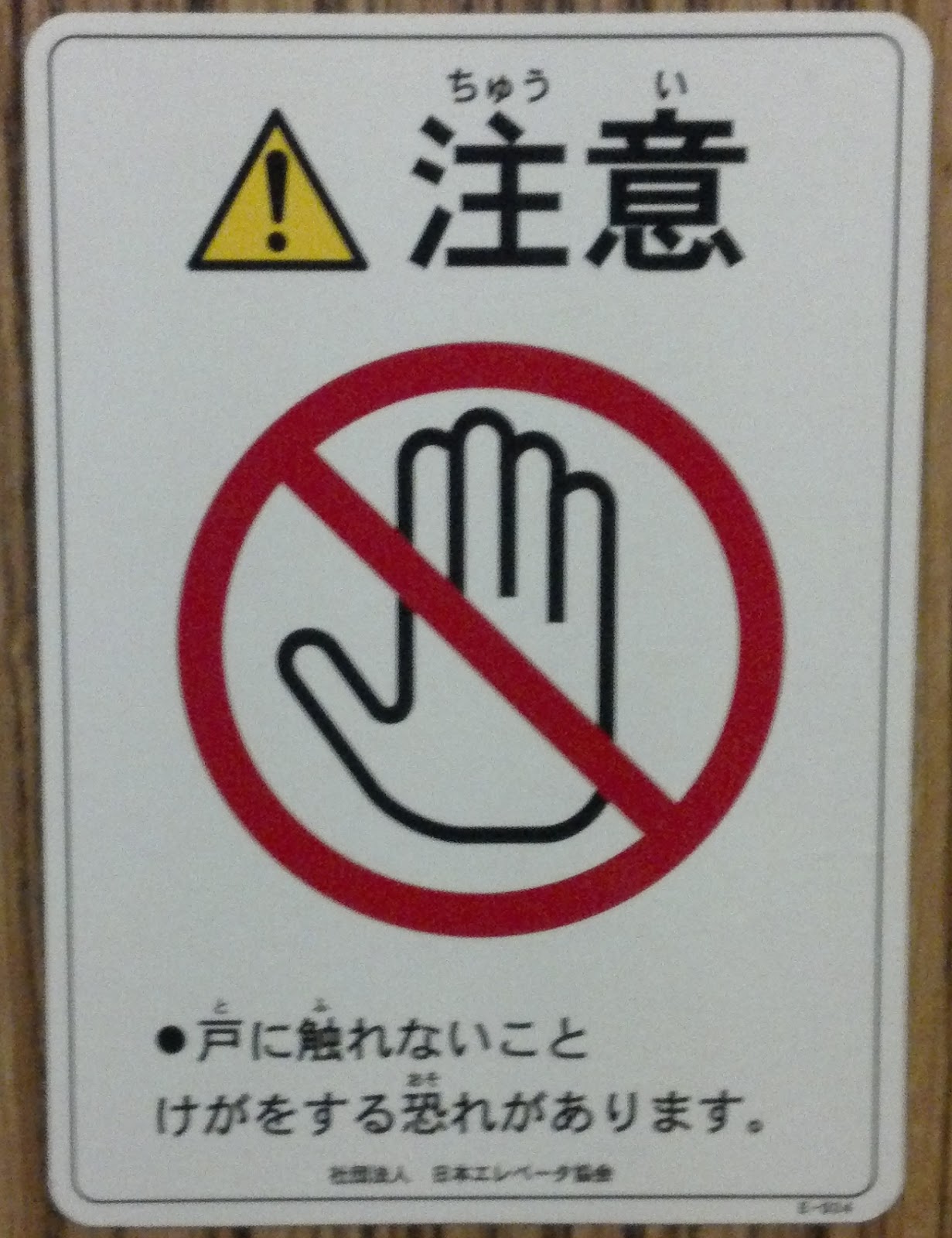
注意:Watch out!!!

If you come to Japan, you will probably see this picture (or these words) in many places that you go:

Stop, in the name of love...

I took this picture inside an elevator (エレベーター), but you can find it on tons of other signs in tons of different places. I've found this on signs telling you to pick up your dog poop or on power generators on the side of buildings. So what is this word!?

注意
( ちゅうい / chuui )

This is Japan's version of "caution", "warning", "attention", or simply, "watch out!!" This word is made up of the kanji "to pour" (注) and "opinion" or "thought" or "feeling" (意). Basically you can think of this as meaning: "Pour your thoughts into this."

When you really think about it, if you really pay attention to something, you are pouring your attention or thoughts into it. And, if you're not, you're probably not cautious enough.

Well, again if you see this sign it could mean something really important...but at the same time, it usually just means to "use your brain a little"; don't put your hand here (or you'll lose a finger), pick up your poo (or someone's gonna be mad when they step in it), and don't touch this (or you're gonna die of electrical shock).

So everyone please 注意!

みんな、がんばって!
Monday, October 29, 2012

仕事: True work involves serving others

Today's word should be memorized by anyone who wants to work in Japan. That word is:

仕事
( しごと / shigoto )

Or in other words, "work" or "employment" or "occupation" if you really want to get technical. You can use this word as a noun or you can use it as verb with the addition of "suru" (する). 

A closer look at the kanji will probably give you a closer look at Japanese society altogether. The first character means "serve" (仕) while the second basically means "business" (事). All in all, if you put these two together, your roughly get a feeling of a business based upon service.

I think the Japanese really live up to the word "shigoto" and you can see it in everything that they do. The customer is on a higher level (especially in terms of formal language) and is treated with the utmost respect. Even the lowest of workers (at least in Americans' eyes) are trained to serve the customer with outstanding dignity and respect.

Anyways, learn this word and then enjoy this picture of a gas attendant in Japan (and hopefully chuckle a little, ok?)

Japanese gas workers will do anything to serve you, even if they are really short
Anyways, keep studying and がんばって!
Thursday, October 25, 2012

芋: Japan's Sweet Potatoes

Well, I've told many people that when I went to Japan I would become a farmer. Well, I have kept my word. I have begun to live off of the land. Truth be told, I'm not really doing anything other than "glorified weeding", but hey, a samurai's got to start somewhere right?

Today, I started off by chopping some vines that normally grow around the potatoes. My wife's grandpa (ojichan) would cut the vines and I would chop them up with a fancy samurai/farming blade contraption. I'd take the chopped pieces, load them into a wheelbarrow, and then drop em off at the compost area (actually I don't know what it's called, but, hey, I can't be too far off). 

Repeat the process four more times.

Some of you might be thinking that this is pure drudgery and slave labor, but I actually enjoyed it. I love testing myself and finding fun ways to do boring things, so I made it into a game (where I was the only player). I would try to do the process as fast as I could and even ended up running with the wheelbarrow. I'm sure all the neighbors were goggle-eyed at seeing a foreigner running across the street with a wheelbarrow full of vines, but alas 'tis the price of having fun.

Ojichan then handed me the hoe and let me harvest the potatoes. Oh, what a great experience! I really didn't do much, but I honestly enjoyed the fact that I was "kinda" farming and not just "weeding". Well, for those of you (like me, a few hours ago) who don't know how to harvest potatoes. You basically hoe the earth a bit away from where you think the potatoes are, pull up, and then smile as you see potatoes start breaking free from the ground. After that, you simply stick your hands in, grab the potatoes, and then yank em free.


And that's what these suckers look like. Now, this picture gives no justice to these bad boys. Some of them are actually quite big. In fact, let me show you:

Say hello to my little friend
This imo was like the size of a coconut! Look at that thing! Imagine if you saw that on your dinner plate. I mean, I've never seen a potato so large. Anyways, after the hoe-ing, we used some blade-like tools to cut off the roots and smaller vines from the potatoes and then called it a day.

I would say that I have successfully leveled up my farming skills today. I hope that in a few more levels, I can change classes and maybe become a fisherman. Until then, またね~